Many familiar trees do not fit the main groups. Here are the commonest, with the feature that gives each away.
Identifying other common broadleaf trees
Scientific name: various
Tulip tree
Leaves with four lobes and a square-cut tip. Tulip-like green-orange flowers in late spring and upright cones of seeds. Tall, straight trunk with ridged bark.
Sweetgum and sycamore
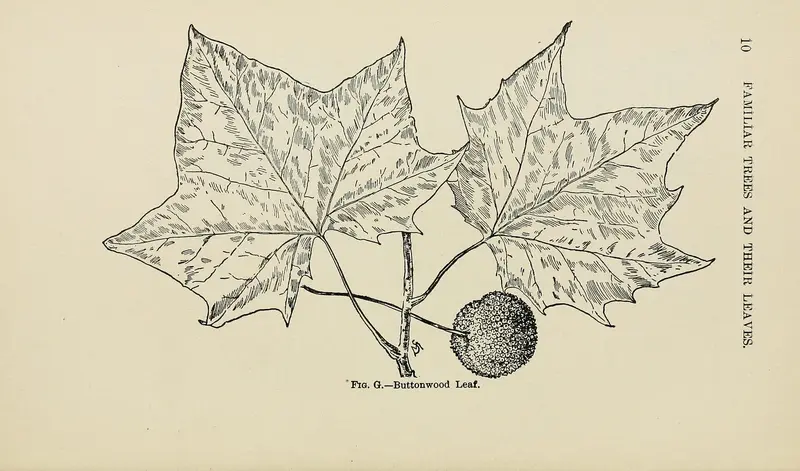
Sweetgum has star-shaped, alternate leaves, a spicy smell when crushed, and spiky round fruit balls. American sycamore has big, shallowly lobed leaves, mottled bark that flakes in patches to show creamy white beneath, and single round fruit balls on a long stalk. Both look maple-like but are alternate.
Cherry, apple and beech
Black cherry has glossy, finely toothed oval leaves and dark, upturned bark flakes like burnt cornflakes. American beech has smooth grey bark, straight side veins ending in teeth, and long slender buds. Its dead leaves cling on in winter.
Dogwood and redbud
Flowering dogwood has opposite, smooth-edged leaves with veins that curve towards the tip and four showy white bracts in spring. Eastern redbud has heart-shaped leaves and pink flowers that open on bare branches before the leaves.
Locust, basswood and sassafras
Black locust has alternate compound leaves, pairs of short thorns and hanging white flowers. American basswood has big lopsided heart-shaped leaves and fragrant flowers hanging from a leafy bract. Sassafras has leaves of three shapes (unlobed, mitten and three-lobed) and a spicy smell.
Horse chestnut and buckeye
Opposite compound leaves with five to seven leaflets from a single point, big sticky buds, and glossy brown seeds in spiky or smooth husks. The seeds are not edible. Horse chestnut is native to the Balkans and widely planted.
Trees in this group
- Tulip treeLiriodendron tulipifera
- SweetgumLiquidambar styraciflua
- American sycamorePlatanus occidentalis
- Black cherryPrunus serotina
- Flowering dogwoodCornus florida
- Eastern redbudCercis canadensis
- Black locustRobinia pseudoacacia
- American beechFagus grandifolia
- American basswoodTilia americana
- SassafrasSassafras albidum
- Horse chestnutAesculus hippocastanum