Oaks have alternate leaves, a cup-capped acorn and buds crowded at the tip of each twig.
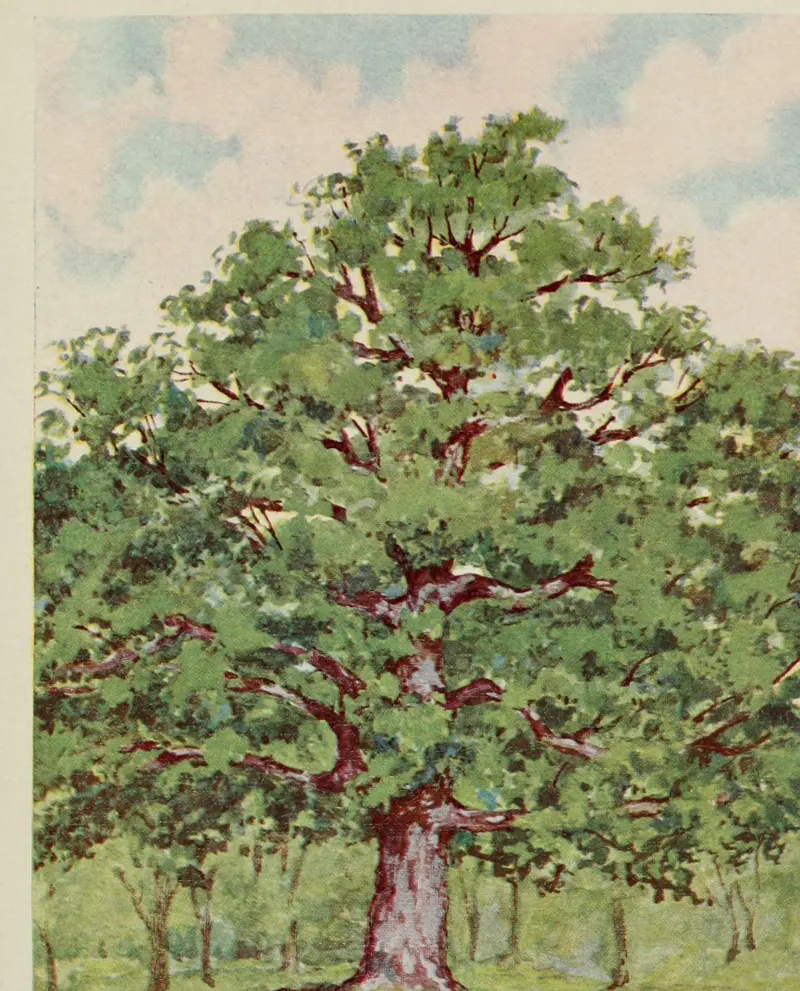
Identifying oak
Scientific name: Quercus
How to recognise it
- Leaves are alternate and simple. Most oaks have lobed leaves, though some oaks have plain or toothed leaves.
- The fruit is an acorn in a scaly cup.
- Buds cluster at the end of the twig.
- Spring flowers hang as catkins.
Two groups
In the white oak group, the lobes are rounded. In the red oak group, the lobes are pointed and have a bristle at the tip. That one check places most North American oaks. White oak acorns ripen in one season and have a sweeter kernel. Red oak acorns take two seasons, are more bitter, and are often held in a flatter cup.
Common oaks
- White oak (Quercus alba): rounded lobes, pale scaly bark, a majestic spreading crown.
- Northern red oak (Q. rubra): pointed, bristle-tipped lobes, ridged bark with pale streaks, and fast growth.
- Pin oak (Q. palustris): deep lobes with rounded gaps, small round acorns and drooping lower branches.
- Southern live oak (Q. virginiana): evergreen, leathery, mostly unlobed leaves and a spreading crown.
- Turkey oak (Q. cerris), a Eurasian species with deeply lobed leaves, is planted widely in Europe.
Not every oak is deciduous
Some oaks keep their leaves in winter, such as live oaks and holm oak. Their leaves are leathery and often unlobed. Young deciduous oaks may hold dead brown leaves on the tree until spring.
Oaks and wildlife
Oaks are among the most valuable trees for wildlife. Their acorns feed jays, squirrels, deer and turkeys, and their leaves support a great many caterpillar species.
Oaks in Britain and Europe
The two native oaks of Britain are English oak (Quercus robur), with short-stalked leaves and long-stalked acorns, and sessile oak (Q. petraea), with long-stalked leaves and stalkless acorns. The Woodland Trust has detailed guides to both.