Hickories are tall eastern trees of the walnut family with large compound leaves and sweet or bitter nuts.
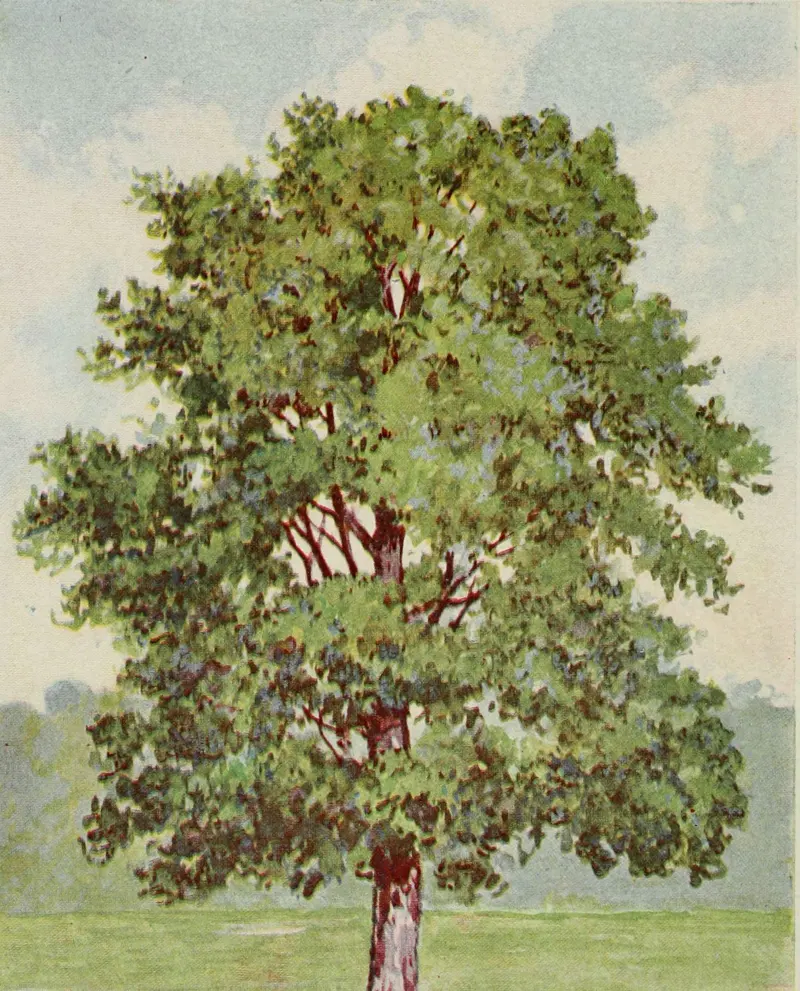
Identifying hickory
Scientific name: Carya
How to recognise it
- Alternate leaves divided into five to nine or more leaflets, with a leaflet at the tip.
- A nut inside a husk that falls with it, often splitting into four.
- Twigs with solid pith.
- Large terminal buds with a few overlapping scales.
Six common hickories
- Shagbark hickory (Carya ovata): five leaflets, long peeling strips of bark, thick husk.
- Shellbark hickory (C. laciniosa): larger leaves with seven leaflets, also shaggy, with larger nuts.
- Bitternut hickory (C. cordiformis): sulphur-yellow buds, thin husk and bitter nuts.
- Pignut hickory (C. glabra): tight bark and small, pear-shaped nuts.
- Mockernut hickory (C. tomentosa): hairy twigs and leaf stalks, and large buds.
- Pecan (C. illinoinensis): 9 to 17 narrow leaflets, grown for its nuts across the south.
Walnut or hickory?
Slice a twig lengthwise. Hickory pith is solid, and walnut pith is chambered. Walnuts have more leaflets, usually 11 or more, and round, unsplit husks.
Uses
Hickory wood is dense, strong and shock-resistant, and was used for tool handles, wagon wheels and skis. Hickory smoke is widely used to flavour meat, and hickory nuts are food for people and wildlife.